If you’re managing an oil storage, fuel depot, or terminal expansion project in Kenya, the tank construction package is usually where the schedule and the budget are won or lost. Get the wrong subcontractor and you inherit rework, failed hydrostatic tests, and a welding crew that’s never actually built to API 650 before. Here’s what to check before you sign a tank construction subcontract in Kenya or the wider East Africa region.
Why API 650 matters more than the price quote
API 650 is the American Petroleum Institute standard for welded steel storage tanks for oil storage — and it’s the benchmark most terminal operators, insurers, and lenders in East Africa expect a tank to be built to, even outside the US. It covers everything from plate material selection and shell course design to weld procedures, foundation tolerances, and hydrostatic testing.
A contractor who quotes low but has never run an API 650 build before will usually cut corners in one of three places: plate material traceability, weld procedure qualification, or foundation settlement tolerance. All three are expensive to fix after the fact — foundation issues in particular can mean re-pouring a ring wall under a half-built shell.
What to verify before you award the package
1. Welding procedure qualifications (WPS/PQR). Ask for the contractor’s qualified welding procedures and welder certifications specific to the plate thickness and material grade on your job — not a generic certificate from a different project.
2. Plate rolling and fit-up capability. Tank shells are built from rolled steel courses stacked and welded vertically. Ask to see photos or references of shell courses the contractor has actually rolled and erected, not just fabricated flat steel.
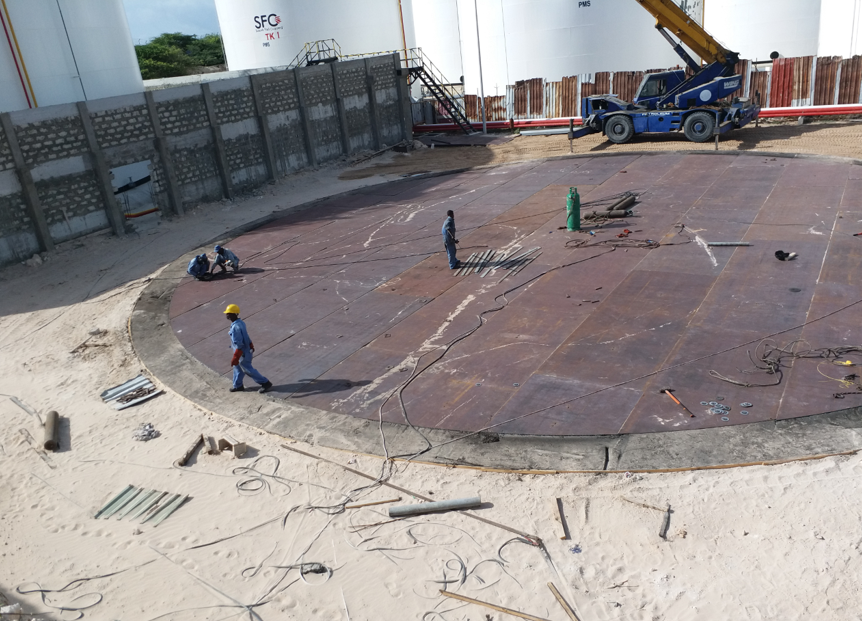
3. Foundation and ring wall experience. The tank foundation has to be level to within millimetres across a diameter that can run to tens of metres. This is civil work that has to happen before any steel goes up, and it’s usually where inexperienced contractors lose the most time.
4. Roof type and structural steel scope. Fixed cone roofs, dome roofs, and floating roofs all have different structural steel requirements. Confirm the contractor has actually erected the roof type your design calls for — a dome roof (like the ones common on LPG-adjacent tankage) is a different skillset from a flat cone roof.
5. Hydrostatic testing and NDT. Non-destructive testing (radiography or ultrasonic testing of welds) and hydrostatic testing are non-negotiable sign-off steps. Ask who performs it — an in-house team or a third-party inspector — and get that in writing in the subcontract.
What a full-package tank construction scope actually includes
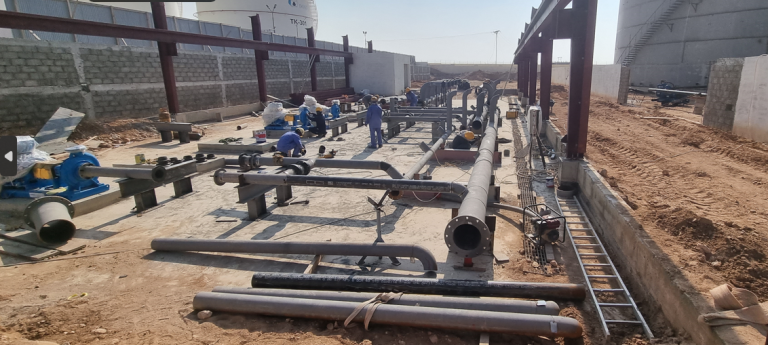
On the terminal and tank projects we’ve delivered — including full-package tank construction and structural steel works — the scope typically runs:
- Ring wall / foundation civil works
- Plate rolling, shell erection, and vertical/horizontal seam welding
- Roof structure fabrication and erection (cone, dome, or floating)
- Nozzle and manway fitting
- NDT and hydrostatic testing
- Painting and coating to spec
- Final walkdown and handover documentation
Treating these as one coordinated package — rather than splitting civil, mechanical, and coating across three separate subcontractors — is usually what keeps a tank farm build on schedule, because the handoffs between trades happen inside one team instead of across three different companies’ calendars.
A regional note: building to standard in markets with less local oversight
In parts of the region — including terminal projects in Somalia and Puntland — there’s less local regulatory inspection infrastructure than in, say, a major Kenyan port city. That makes the contractor’s own internal quality control the main safeguard on the project. Ask specifically how a contractor handles quality assurance on sites where there isn’t a government inspector showing up to check ring wall tolerances or weld quality. If they don’t have a clear answer, that’s worth pausing on.
Working with a contractor who’s done this before
Karoep General Engineering Limited has delivered full-package tank construction and structural steel works on terminal projects across the region, including tank construction and structural steel works sub-contracted at SFC Mogadishu and technical support to LPG mechanical and civil construction at an East Africa terminal. If you’re scoping a tank construction package in Kenya, Somalia, or elsewhere in East Africa and want a contractor who can walk you through foundation-to-handover experience, get in touch — we’re happy to talk through your specification before you go to tender.