LPG terminal projects get scoped differently to a standard fuel tank farm, and that trips up procurement teams who are used to buying tank construction as a single line item. LPG storage — usually spherical or “mounded” pressure vessels rather than atmospheric tanks — carries different foundation loads, different structural steel requirements, and a tighter mechanical scope. Here’s how the civil and mechanical works actually break down on an LPG terminal build in East Africa.
Why LPG terminal construction is a different build to a standard tank farm
LPG is stored under pressure, which means the vessels are usually spherical or cylindrical pressure vessels rather than the flat-bottomed atmospheric tanks used for diesel or crude storage. That changes almost everything downstream:
- Foundations have to carry a concentrated point-load pattern from the vessel support legs or saddle, rather than a distributed load across a tank’s full base area.
- Structural steel scope often includes support cradles, access platforms, and blast-resistant design considerations that a standard tank farm doesn’t need.
- Mechanical works bring in piping classes, valve manifolds, and relief systems rated for LPG service pressures, which is a different specification to atmospheric tank nozzles.
Terminal operators who scope an LPG project the same way they’d scope a diesel tank farm tend to under-budget the foundation and structural steel package specifically.
The civil works scope on an LPG terminal
Civil works on an LPG terminal typically start well before any steel arrives on site:
- Site grading and drainage — LPG sites need specific drainage and bunding design given the flammability risk profile.
- Foundation construction — pile caps or mat foundations sized for the vessel support load, plus foundations for pump houses, control rooms, and access roads.
- Underground and above-ground piping trenches — coordinated early so mechanical piping installation isn’t waiting on civil works to catch up mid-project.
The mechanical works scope
Once foundations are ready, mechanical works cover:
- Vessel or sphere erection onto the completed foundation
- Structural steel support and access platform erection
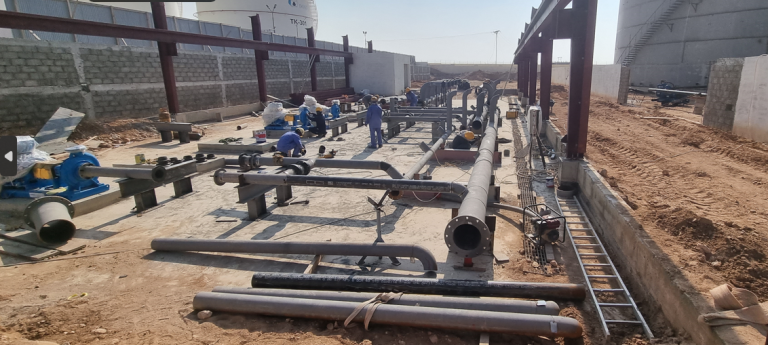
- Process piping fabrication and installation, including relief and flare systems
- Valve, manifold, and instrumentation tie-ins
- Pressure testing of the full piping and vessel system before commissioning
Where projects lose time
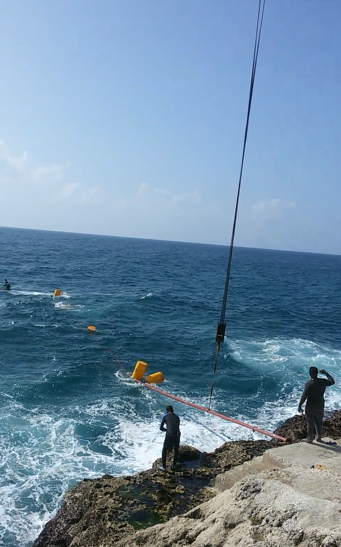
On LPG terminal builds we’ve provided technical support for — including LPG mechanical and civil construction works at an East Africa terminal, and LPG terminal technical assistance during construction in Berbera, Somaliland — the recurring bottleneck isn’t the vessel erection itself. It’s the sequencing between civil and mechanical crews. If foundation civil works aren’t handed over cleanly (right elevations, correctly positioned anchor bolts, cured to spec) mechanical erection stalls, and that stall is expensive on a site where equipment and crews are mobilised and on the clock.
The fix is straightforward on paper — a single contractor coordinating both scopes, or at minimum, a shared schedule with real handover checkpoints between the civil and mechanical teams rather than two subcontractors working off separate programmes.
A note on remote and cross-border sites
LPG terminal projects in the region often sit in locations with less established local supply chains — Bosaso, Berbera, and similar ports don’t have the depth of specialist mechanical contractors that a market like Mombasa does. That makes contractor mobilisation capability — can they bring their own crews, welding equipment, and lifting gear to a remote site and be self-sufficient — a real differentiator, not a nice-to-have.
Delivering LPG terminal works across the region
Karoep General Engineering Limited has provided technical support to LPG civil and mechanical construction works at an East Africa terminal and LPG terminal technical assistance during construction in Berbera, Somaliland. If you’re planning an LPG terminal project and want a contractor who understands the civil-to-mechanical handover on pressurised storage builds specifically, reach out to talk through your scope.